Before the Sketch Show: A Short History of the Variety Bill
The variety bill brought different comic acts together in one evening; learn how its format shaped performance and differs from a sketch show.
The variety bill put comic songs, spoken turns, and specialty acts on the same program, without requiring them to share a story. Its history is clearest when treated as a format: a way to book, order, and present distinct performances for one audience.
Separate acts, shared program
A variety bill is a sequence of separate performances at one venue. A singer might follow a comic storyteller, with an acrobat or character performer later in the program. Each act brings its own material and style; the venue and running order connect them.
That structure differs from a play, which usually follows one sustained dramatic world, and from a sketch show, where scenes are the central units and a recurring company or writing voice may bind them together. Variety could include scripted comedy, but its acts did not need common characters, plot, or authorship.
The distinction matters historically. A bill could bring specialists into the same entertainment without turning them into a troupe. The format made the program itself the organizing unit, rather than a single narrative or comic ensemble.
Music hall and vaudeville
Music hall and vaudeville are useful names for traditions associated with mixed bills, though they do not describe one identical institution or period. British music halls became known for programs combining songs, comedy, and other attractions. Vaudeville became a prominent American form of variety entertainment, with bills that could include comic turns, music, acrobatics, and novelty acts.
These examples make the broad history more concrete without reducing variety to one origin story. The format drew on public entertainments and local performance traditions; its precise character depended on the venue, performers, and audience. “Variety” can name the organizing principle, while “music hall” and “vaudeville” point to particular cultural settings.
Comedy shared those stages with non-comic acts. That placement shaped its meaning: a comic monologue or song could be one part of an evening that also offered music or physical skill. The bill’s identity came from the mix, not from comedy alone.
Booking and order
A bill’s sequence could distinguish acts by their materials, not just by their pace. A comic song depended on lyrics and melody; an impersonation relied on recognizable mannerisms; an acrobatic specialty foregrounded physical skill. The program let audiences compare different kinds of performance in one sitting.
For a booker, the practical question was how each act would register in the room and how it would sit beside its neighbors. A turn might need a piano, a clear playing area, or a quiet audience. Those needs could affect placement as much as the comic style. This is a history of labor and presentation, not merely a recipe for comic rhythm.
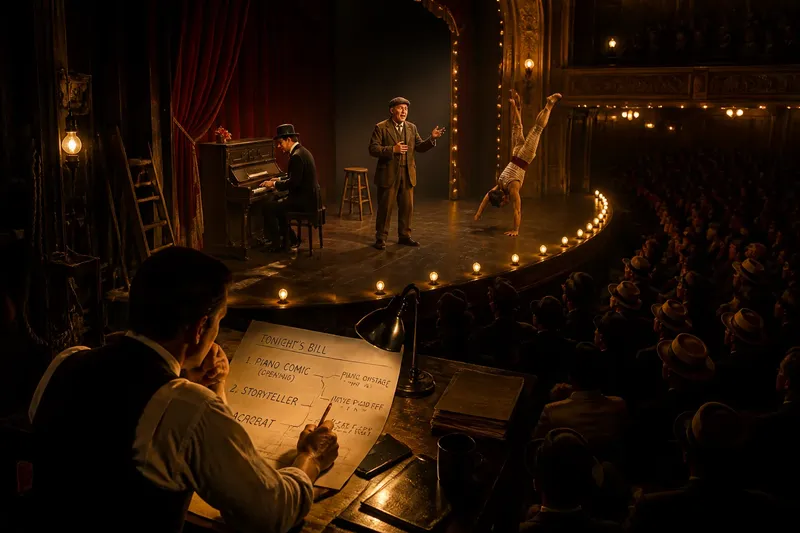
Imagine a fictional neighborhood theater planning a bill with a piano comic, a storyteller, and an acrobat. The manager notes that the piano must be onstage for the opening act and that the acrobat needs a cleared floor. The manager books the piano comic first, places the storyteller after the piano is moved, then schedules the acrobat once the stage is cleared. The observable result is a program whose changes of performer also account for the work of resetting the stage.
What do readers ask?
What is a variety bill?
It is a program of distinct acts presented in sequence, often mixing comedy with music and specialty performance. The acts share a venue and audience, but not necessarily a story or cast.
How does vaudeville relate to variety?
Vaudeville is a particular American tradition of mixed entertainment bills, while variety can describe the wider format. The terms overlap, but “variety” does not refer only to vaudeville.
Was every act comic?
No. A bill could include musical or specialty performances that were not primarily comic. Their different skills and moods helped define the program as a mixed entertainment.
Did variety bills become sketch shows?
Variety and sketch shows share an interest in presenting short units, but they are not simply successive versions of the same form. Sketch shows center scripted scenes and often use a recurring company, while variety bills can place unrelated specialist acts together.
Radio and television
Broadcast programs adapted the mixed-program principle to a new medium. Radio could place songs, comic monologues, and short performances within one show; television could add visual acts and character appearances. The broadcast program, rather than a theater stage, became the shared container.
That resemblance does not make every broadcast variety show a direct copy of a stage bill. Radio and television had their own production demands, including microphones, cameras, and transitions between segments. The useful historical connection is narrower: both forms could hold distinct kinds of performance under one program title.
To tell a variety structure from a sketch structure, ask what connects the pieces. A host, venue, or sequence may be enough for a variety bill. A sketch show may rely more on recurring performers, linked scenes, or a shared comic voice.
How to recognize the form
When you watch or read about an older mixed program, look for evidence of its organization as well as its jokes. A surviving running order, program listing, or stage description can show which kinds of acts shared the bill and how the venue presented them.
- If a program lists unrelated performers and specialties, treat it as evidence of a mixed bill; if the entries instead follow one continuous cast and plot, consider a play or revue.
- If the listed acts include both comedy and music, describe the program as mixed entertainment; if every entry is a comic scene, examine whether “sketch show” fits better.
- If a host introduces separate performers, note the host as a possible link between turns; if no host appears, look for the venue or running order as the program’s frame.
- If a listing names equipment or a stage arrangement, use that detail to discuss presentation needs; if it gives no such information, avoid guessing how the act was staged.
- If performers appear under separate names or specialties, describe their distinct roles; if the same company recurs across scenes, consider whether ensemble continuity is central.
- If a source identifies a specific tradition such as music hall or vaudeville, use that bounded term; if it only describes a mixed program, call it a variety bill without assigning a tradition.
The search phrase “history of the variety bill” points to more than a lineup of old acts. It names a format that brought different performers into one program while leaving their specialties intact. That distinction helps explain why variety influenced later entertainment without becoming another name for the sketch show.